How 80G Registration Can Maximize Your Nonprofit's Donor Contributions
Learn how 80G registration can maximize your nonprofit's donor contributions. Boost your NGO's funding potential with expert guidance from CA4Filings.
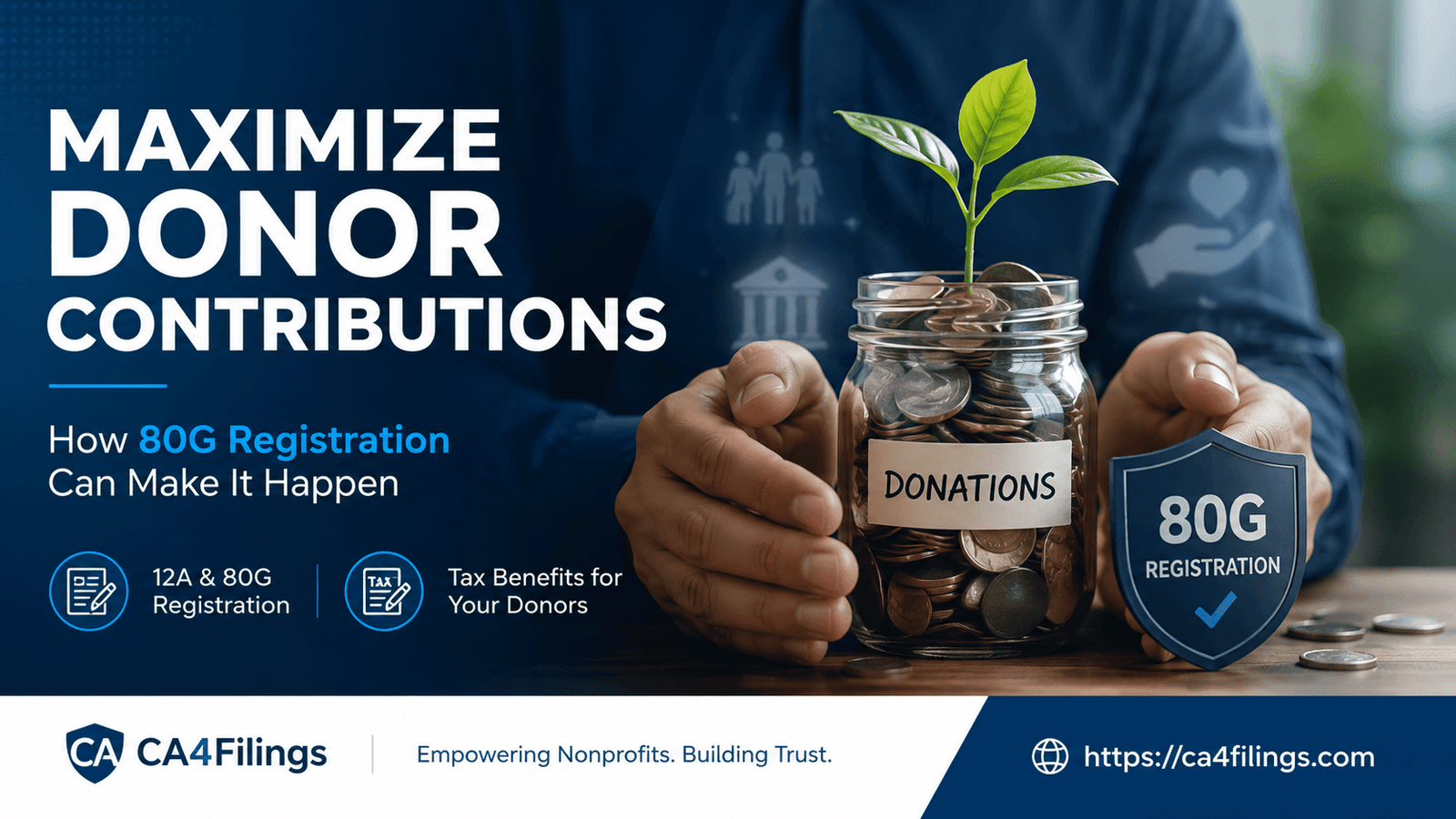
Running an NGO in India is a noble journey, but let’s be practical—good intentions alone don’t keep the lights on. Every NGO founder eventually faces the same challenge: how to attract consistent, high-value donations. As a Chartered Accountant here at CA4Filings, I often see amazing organizations struggling to scale simply because they haven't optimized their legal standing. If you want to take your fundraising efforts to the next level, obtaining 12A and 80G registration is perhaps the most strategic move you can make. Understanding how 80G registration can maximize your nonprofit's donor contributions isn't just about tax law; it’s about unlocking the psychology of giving.
What Exactly is 80G Registration?
In simple terms, Section 80G of the Income Tax Act, 1961, allows donors to claim a deduction for donations made to certain charitable organizations. When your NGO holds a valid 80G certificate, you are essentially telling your donors, “If you support our cause, the government will reward you with a tax break.”
It acts as a government-endorsed stamp of legitimacy. Without it, a donor gives you their money, and that’s the end of the transaction. With 80G, the donor feels they are effectively paying less tax while doing good. It transforms a simple donation into a smart financial decision for the donor.
Why Donors Care About Your 80G Status
In today’s competitive philanthropic landscape, donors—especially corporates and high-net-worth individuals—are extremely particular about where their money goes. They aren't just looking for a good cause; they are looking for tax efficiency and organizational transparency.
If you don’t have this registration, you are effectively leaving money on the table. A potential corporate partner, who has a CSR (Corporate Social Responsibility) budget to spend, will almost always prioritize an NGO that provides an 80G receipt because it helps them fulfill their tax obligations.
How 80G Registration Can Maximize Your Nonprofit's Donor Contributions
Many NGO owners ask me, “Does this really bring in more money?” The answer is a resounding yes. Here is how it works in the real world:
1. The Trust Factor
Legitimacy is everything. Obtaining 80G status involves a rigorous verification process by the Income Tax Department. Once you have it, you gain instant credibility. Donors trust that your organization is audited, transparent, and compliant. This trust is the foundation upon which large donations are built.
2. Tax Incentive for the Donor
When a donor knows their contribution is tax-deductible, they are often willing to give a larger amount. For example, if a donor is planning to give ₹50,000, but they realize that a portion of that will be deducted from their taxable income, they might actually increase their donation to ₹75,000. How 80G registration can maximize your nonprofit's donor contributions lies in this very phenomenon—it effectively lowers the "cost" of giving for your supporters.
3. Access to Corporate Funding
Large corporations and MNCs have strict compliance departments. They do not donate to unregistered or non-compliant entities. By securing your registration, you open the door to institutional funding, which is far more consistent than individual, small-scale donations.
The Path to Getting Registered
The process has become more streamlined under the new Income Tax rules, but it still requires precision. Here is the general flow we follow at CA4Filings:
Preparation of Documentation: You need your Trust Deed/Registration documents, audited financial statements for the last three years (or since inception), and a detailed report on your charitable activities.
Filing Form 10A: We file the application electronically on the Income Tax portal.
Verification: The department scrutinizes your charitable objects and activities to ensure they align with the law.
Grant of Approval: Once satisfied, the department issues the 80G registration.
Common Pitfalls to Avoid
Even with the best intentions, I’ve seen many NGOs get rejected due to avoidable errors:
Incomplete Activity Report: Providing vague descriptions of your work is a major red flag. Be specific.
Financial Discrepancies: Ensure your books of accounts are perfectly aligned with your reported income.
Non-compliance with New Rules: The government recently mandated a re-registration process. Ensure your documentation is updated for the new provision.
Frequently Asked Questions
Can I accept donations before getting 80G?
Yes, you can accept donations, but those donations will not be tax-deductible for the donor. You will lose the benefit of attracting donors who specifically look for tax-saving opportunities.
Is 80G registration a one-time process?
No, it now requires periodic renewal to ensure that organizations remain compliant with their charitable objectives.
Does 80G apply to foreign donors?
No, 80G is strictly for domestic donors within India. For foreign funds, you need FCRA registration, which is a completely different process.
How long does the process take?
With the current digital filing system, if your documents are in order, the process is much faster than it used to be. However, it still requires patience and professional handling.
At the end of the day, your NGO is doing incredible work, but you need the right tools to sustain and grow that impact. How 80G registration can maximize your nonprofit's donor contributions is not just a theory; it is a proven strategy that separates thriving, long-term NGOs from those that struggle year after year.
Latest Updates
ca4filings.com Services





















-registration.png)